>

>

Saturday, 4 February 2017

Personal Learning Network and The Connected Student - TT6

     Today we had a presentation delivered by John Evans from Manitoba Ed and one of the topics he talked about was the huge change in each personal learning network (PLN). The PLN is growing so fast and expanding like crazy! John explained that back when he graduated from Brandon U Education in 1980 his PLN looked something like the following:

by A. Couros: http://www.flickr.com/photos/courosa/344832659/

     Now with the advent of so many online platforms designed for reflection and sharing the teacher network has evolved into something like the following:
by A. Couros: http://www.flickr.com/photos/courosa/2922421696/

     This figure is even beginning to shift as well. These diagrams are just another testament to the amount of information out there that requires some sifting. "Getting information off the internet is like taking a drink from a fire hydrant" John explained. Except the water is tainted. There is a huge amount of fake news/facts out there that it's overwhelming. Even in articles that are posted from credible sources can be well beyond misleading. "we have to develop our crap detectors". We need to work on our critical analysis reading skills so that we can show our students how to detect internet lies. We have to help them develop a information filter to discern between not just whats important but whats factual.

     I've started the process of trying to organize my own PLN and so far it looks like the following:
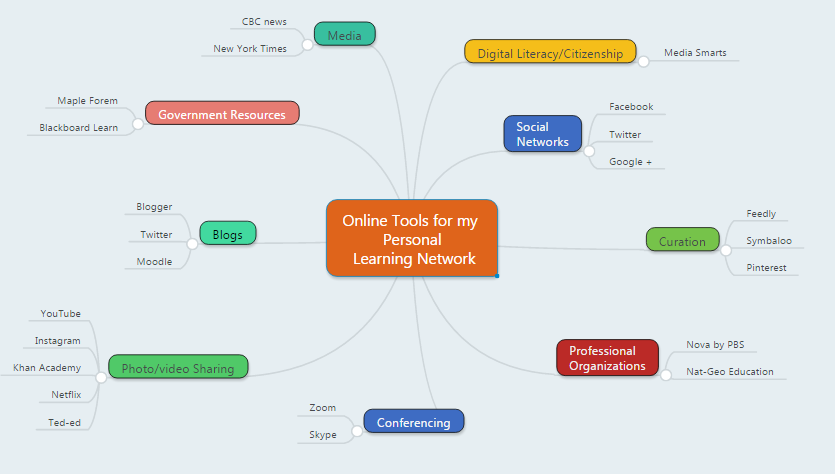

     This is only the beginning as well. As I type I can think of quite a few more items that need to be added. I really like the idea of creating a PLN using a mind mapping tool. Mindmeister was used for my own. The map is a good way to keep track of which networks are still being used frequently and which could be touched upon again. 
     Students should be aware of what their PLN's are as well. They build them without thinking about but creating a small assignment where they map their sources would really adjust their attention. I have created a map of what a student PLN may look like and hope to update the image with the upcoming teaching practicum:


Thursday, 2 February 2017

Social Media Literacy - Week 4


     This week  I had the opportunity to read an interesting article posted on educause.edu and written by Susan Mehringer. The article outlined some very important facets of social media literacy that I have not ever encountered before. In fact, I have never really seen anyone attempt to break down social media literacy into its constituents. I find this task a bold undertaking since social media is ever changing and that by the time a person would be done researching and organizing necessary info, the entire platform could have changed already; a common aspect of any digital tool. In Mehringer's article, the outlined facets are attention, participation, collaboration, network awareness, and critical consumption. She puts particular emphasize that attention is the fundamental aspect with an interconnected web of the other 4 being used without any possible specific use of one in isolation. 

Attention: 
     Mehringer brings up many great points when it comes to student attention in classes where laptops are permitted. Her main idea though is not to ban social media and online distractions from the class but to make students aware of where their attention is being directed. She performs a few probing social experiments on the students to accomplish this. Her end goal is to allow students to gain some perspective of what it means to connect to their public voice and the implications of doing so. She emphasizes that the focused attention should be place on what they are saying with consideration of others i.e. information outside our focal area.

Participation:
     Mehringer states that we must participate in a way that is valuable to others and become active digital citizens. Technology is a "...powerful engine of participation." Today's social platforms allows people to inform, persuade, and influence the beliefs of others through active participation. The power of which grows with the ability to organize large groups of people. 

Collaboration: 
     With social media, people can collaborate in ways that were too difficult and costly before. The benefits of the power for social medias ability to rally large groups quickly can be seen around the world in influencing political policy and spending, to helping disaster victims. 

Network Awareness:
     Social networks are essential to human well-being and before the advent of online social networks, there were physical limitations on the amount of people that could be included. Now, network sizes are exponential in size, with limitations being what we choose them to be. Educators and learners understand two key notions in terms when deciding who to include in their personal learning networks (PLN), reputation and diffuse reciprocity. Essentially, they base their PLN on if a person is trustworthy or entertaining, or that they will contribute in turn with each other, useful information.

Critical Consumption:
     Critical consumption is the "crap detector" which involves who and what is trustworthy. In order to determine who is trustworthy, we must "Consult them personally, consult what they've written, ad consult their opinion about the subject." If they seem trustworthy afterwards, then we add them to our PLN. This crap detection is largely connected to attention. We must develop strong skills on how to focus our attention on people and information that is useful to us amidst the immense flow of information online.

I'll leave this post with one final quote that Mehringer, "... if we want to discover how we can engage students as well as ourselves in the 21st century, we must move beyond skills and technologies. We must explore also the interconnected social media literacies of attention, participation, cooperation, network awareness, and critical consumption."


Tuesday, 31 January 2017

Twitter for Educational Purposes - TT3

I've been thinking a lot lately about how my twitter feed connects to my professional education aspirations. One of the connections I have managed to make is in regards to the constant sharing of ideas. There are so many great educators on twitter and as a pre-service teacher, it is an idea gold mine. Instead of sifting through instructional textbooks and online resources, I can just check my feed for resources that seasoned pros are sharing. It makes my life so much easier,with resources and when it comes to new pedagogical movements as well. What I mean by this is I can see the the changes on the front lines of education. For example, @CSCorganization is constantly posting modern information/resources on things like maker spaces, artificially intelligence, and inquiry or flipped based classrooms. Pedagogy is very dynamic enterprise in which I think twitter will keep me up to date.

Another important aspect of using Twitter as an educator involves constant improvement on becoming a better digital citizen. Our students grow up in a world and social media is just a part of their lives so I feel it is my duty to learn how to responsibly be a part of. I need to know what it means to socialize online and how to properly do so. As educators, we need to be active members of the community which includes the online aspect as well.


Saturday, 28 January 2017

Manitoba Education


     This week in our Internet for Educators course Donald Girouard and Shannon Magee put on a presentation introducing Manitoba Blackboard Learn to us. From what I gathered, Manitoba Blackboard Learn is extensive, Manitoba curriculum aligned online classroom resource available to Manitoba educators. Upon navigating the site I was so impressed! The website offers a friendly user interface for so many great tools. Everything a person needs to run a classroom is there and the course doesn't have to be used exclusively for online classrooms and could be used in a face-to-face setting as well. I can definitely see myself using these courses in the future, especially if I have to teach a class outside of my comfort zone. Lots of the course (especially the newer ones) are interactive as well so this should help with classroom engagement. Of course I would let the website do the the teaching but it is a great resource for new teachers for sure. All students need to signup is their MET number too so there shouldn't be a huge issue with privacy.


I have to say that the fact that the Manitoba Government is willing to develop and provide such a powerful online resource really gets me excited to be a Manitoba teacher. This resource really shows that the government is behind us. It seems to be a good time to become a educator.


Saturday, 21 January 2017

Presentation by Alec Couros

This past Thursday, Dr. Alec Couros put on a presentation through Zoom Video to our Internet for Educators class. I couldn't believe how engaged I was considering it as 2 hour slide-show presented over a laptop screen! The insight Dr. Couros brings forth towards educational tech is outstanding. The presentation was full of interesting perspectives that were mostly new to me, but there were two that stood out above the rest. The first was the power of the internet to allow students fingertip access to pretty much the entire data base of human knowledge and secondly, the open-learning style that accompanies it.

The implications to education in terms of ease for student access to information seems its changing the profession. I can't imagine teachers really being seen as the all encompassing knowledge keepers anymore especially when YouTube can pretty much teach a person anything they want to know. We need to adapt to this changing landscape.

This leads to the other point Dr. Couros brought up which is the concept of open-learning. Open-learning is a student centered approach to education where the students interests guide their own education. I could see myself using this in the class-room. The structure is a little looser than the traditional education system but I can imagine student engagement to be much higher. The main challenges I see that would arise though, especially at the senior years level, would be connection to curriculum and assessment. It would be very difficult to ensure that all students are meeting the curricular SLO's when student skills and interests could vary so widely! Not to mention trying to mark 100 assignments that are all different. I imagine the type of assigned work would have to be more project based as well, which in themselves take a lot longer to mark but if the students would benefit from them. I guess it's worth it.

Wednesday, 18 January 2017

Online Curation - TT2

     Online curation of resources is a concept that I have recently been introduced to. It is essentially the collection and organization of the all the websites one visits in a given week. I find the importance of it is it allows for a cognizant way of noticing the websites you love and the ones that are going stale. Prior to collecting in this way I found that I would lose websites or threads that I loved but forgot they existed since I hadn't visited them in so long. Now that I have them in one place, I can easily be reminded and keep connected to sites that feed my online article addiction.

I see online curation is somewhat like writing a research paper. When writing a research paper, there is mounds of documents,texts, and articles that contain a mountain or knowledge that needs to be sorted through. The sifting usually involves highlighting and paraphrasing the key concepts that are necessary additions for the paper. This is similar the cruising the internet for threads, blogs, articles, etc. The internet is the library, the websites are the resources, and the curation platform is the paper. This curation is a synthetic process that leads a neat and organized final product.

     There are many websites that help with this process but the ones that I have been using that seem to be organised and neat are Feedly and Symbaloo. Feedly is great for organizing blogs and websites that continually update material. Symbaloo I use for resources and tools that I use in my teacher toolkit. Symbaloo has a easy to read interface as well that is vastly customizable. I will continue to use these platforms and I'm sure others will get added to collection. Hopefully I don't get to a point where I need a curation platform for organizing my curation platforms 😒😒😒😒.


Thursday, 12 January 2017

Directional Shift


The next few posts over the coming months are going to be a bit different from the previous flow. I would like to continue on with a weekly reflection on some of the aspects of the digital world educators and students are currently navigating. The first is social media for teachers and, digital identity and dualism.

From my very brief experience as an educator, I have seen many educators with social media accounts. It seems like a good idea to me since educators need to be up-to-date individuals with the worlds ever changing society in order to better connect with their students. Social media comes with responsibility though. It's no different in than a student seeing a educator outside the classroom, for example at any sporting event. As a societal role model, a teacher really needs to hold themselves up to a higher civilized standard, especially in a public whether it be a sporting event or through comments on Donald Trumps twitter posts. A persons digital presence is a direct reflection of who they are, when the posts come from themselves of course.

This digital singularity is one aspect that I have recently learned is so prevalent that it is being taught to students. People socialize online as well as in person, so digital civility must be practiced. The concept of digital dualism, where the digital identity is different than physical identity needs to be abolished. Any expression of thought or interaction with another person (whether online or in person) must be met with respect and our youth should have opportunities to learn how to do this.